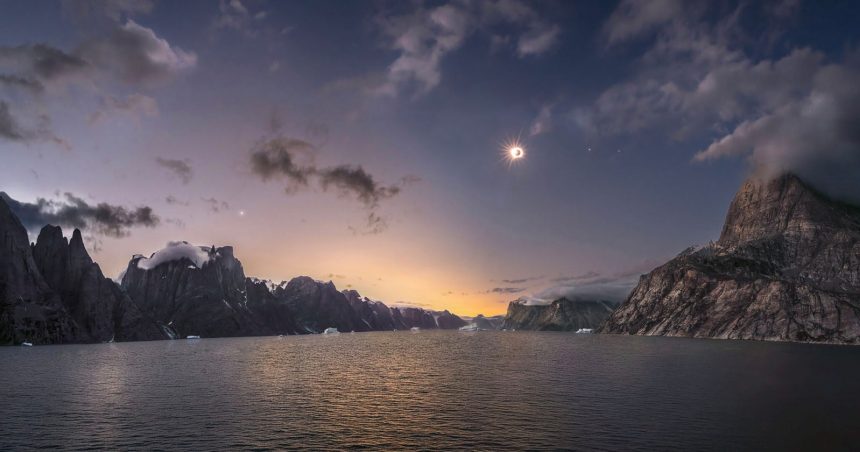
Most eclipse photos look identical: a black disc, a wispy corona, a very long lens. Photographers Marc and Wayne wanted the opposite. When totality swept across the Arctic on August 12, 2026, they positioned themselves not to isolate the sun, but to fold it into one of the most dramatic landscapes on Earth — Greenland’s Scoresby Sund fjord.
The gamble hinged on geometry. This eclipse sat just 25° above the horizon, low enough to become part of a wider composition rather than an event happening straight overhead. That angle meant the sun would hover right above the fjord’s 6,000-foot spires — and the only vantage point that worked was the water itself. They chartered the ship Polar Front and plotted a course to a spot with full totality dead center for over two minutes.
Getting there was its own logistics puzzle. Commercial flights into the remote fjord run only once or twice a week, none aligned with the ship’s schedule, so Marc chartered aircraft — and after his larger plane fell through, two smaller ones with a brutal weight ceiling. Each photographer was limited to 55 pounds covering camera gear and clothes. The workaround: a shared laptop for offloading files to portable drives, the ship’s onboard Starlink, and a crew laundry service.
The one mistake first-timers make
The biggest gear trap is the solar filter. Essential during the partial phases, it must come off the instant totality begins. Leave a 16-to-18-stop filter on and the dimmed sky vanishes into pure black. Marc and Wayne ran deck drills so nobody fumbled during those crucial two minutes.
Even careful planning couldn’t fully prep them. The deep fjord turned out several stops darker than their calculations suggested. Mid-totality, they bumped ISOs and called out settings across the ship in real time — photographers juggling dual-camera rigs, swapping between telephoto corona brackets and handheld panoramas, drones climbing into the twilight where Venus, Jupiter and Mercury had appeared. Holding the ship steady mattered too: at over 500 feet, the water was too deep to anchor, so the captain worked the vessel sideways against a 16-knot crosswind, timing the alignment on Marc’s radio cues.
The hero shots
Marc’s favorite frame came from the drone he’d nearly forgotten was airborne — a single bracketed tap capturing ship, icebergs and eclipse, with the moon’s shadow edge visibly slicing across the water. Shot at f/2.5, 1/15 second, ISO 200.
Wayne improvised a 12-image, multi-row panorama handheld, sweeping across just as the diamond ring flared — sky, mountains and water stitched later using three Photoshop masks. Shot at 1/50 second, f/5.6, ISO 1250.
Their advice for the rest of us: keep a 35mm lens handy (go wider than 28mm and the sun shrinks to nothing), bracket two stops each way during totality, and stop down to f/13–f/16 for the diamond ring’s rays. And resist enlarging the sun in post — the landscape wins.