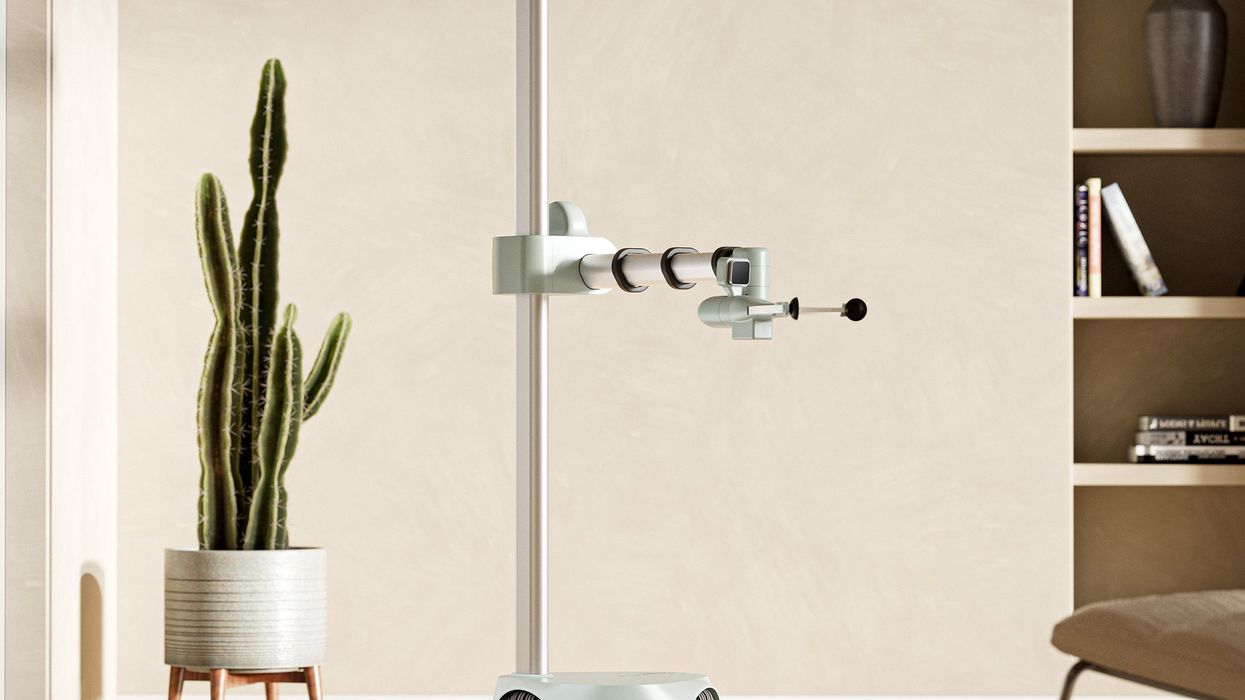
Forget the viral clips of humanoid robots folding laundry in spotless kitchens. Hello Robot’s newest machine, Stretch 4, makes a deliberately unfashionable argument: skip the legs, the arms, the face, and concentrate on the two things that actually matter at home — mobility and manipulation.
“With Stretch 4, we wanted to make the transition from a research platform to something that is truly deployable,” says co-founder and CEO Aaron Edsinger. The result is a wheeled mobile manipulator with an extendable arm that’s ready for research and enterprise buyers now, while Hello Robot uses pilot deployments to figure out how to scale into actual homes.
What’s new
- An omnidirectional base that can translate in any direction without turning first — far easier to control for novice users. It’s built on omnidirectional wheels originally developed for powered wheelchairs, plus six months of focused engineering.
- A redesigned sensorized head replacing the old pan-tilt unit, with a much wider field of view: a pair of hemispherical lidars, Luxonis cameras for vision and navigation, and a wrist-mounted depth camera for manipulation.
- An Intel NUC 15 running the primary system, paired with an Nvidia Jetson Orin NX for researchers tinkering with visual processing or AI.
On the sensor philosophy, Edsinger draws an instructive comparison: “We started out wanting to use lots of cheap cameras to keep costs low, like Tesla does. But we ended up with an approach closer to Waymo’s: the richer and more reliable your data, the safer and more intelligent the robot can be.”
CTO Charlie Kemp describes the build as the company’s hardest design process yet, haunted by “second-system syndrome” — the temptation to cram in every missing feature until you end up with “a monstrosity.” The compromise, he says, “sits in a great spot, rather than being a maximalist humanoid.”
Autonomy, with a human in the loop
Stretch 4 ships with baseline autonomy — mapping, navigation, self-charging — plus demo-ready features like autonomous grasping. But Hello Robot isn’t chasing the data-hoarding playbook of its rivals. “I’d much rather be the platform that foundation model developers target,” says Kemp.
The real target users are people with severe mobility impairments. Henry Evans, paralyzed and a longtime testing partner, puts the case bluntly: “What benefit does a bipedal robot offer to a person who can’t walk? Automobiles don’t have legs, and neither should home robots. Wheels are cheap, stable, precise, require very few controls, and don’t have to be invented.”
Safety seals the argument. “When a wheeled robot gets emergency stopped, it freezes in place,” Evans notes. “When a bipedal robot gets run-stopped, it collapses on anything under it, including the patient.” Kemp doesn’t disagree: “The safety aspect of humanoids in a home freaks me out.”
And here’s the kicker: you can actually buy Stretch 4, at US $29,950 — genuinely affordable as mobile manipulators go. It may not look like Rosie, but it’s safe, and it works.