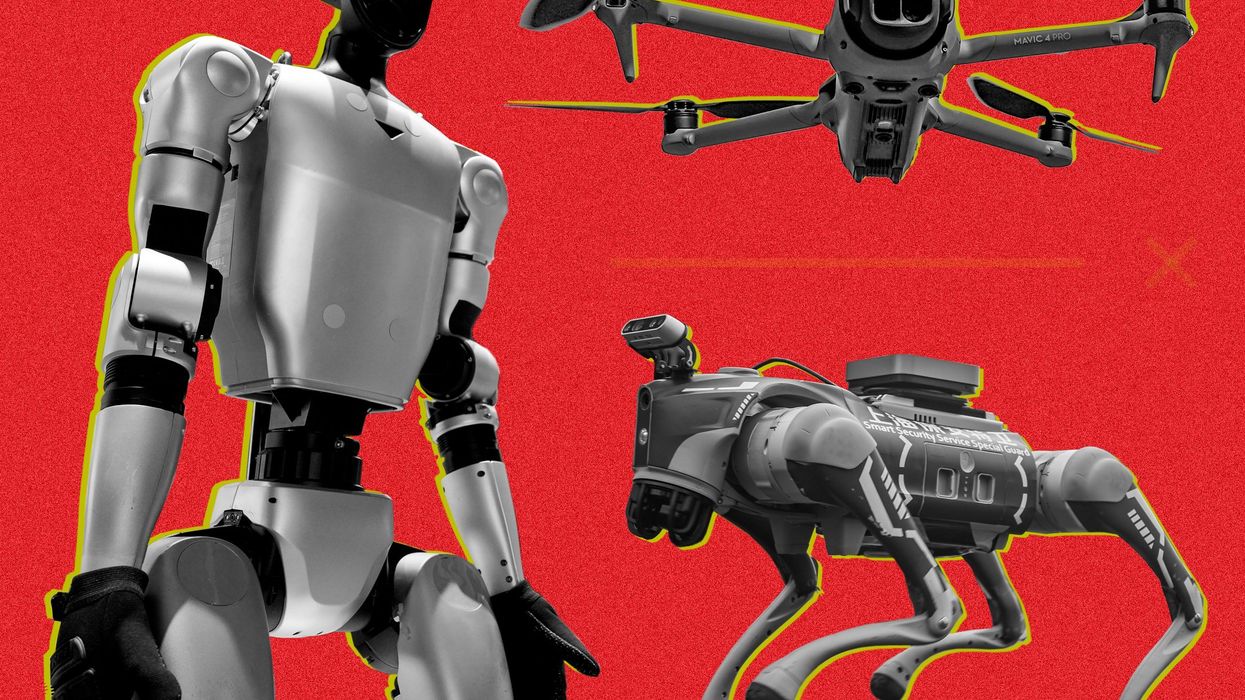
Washington’s tech decoupling from China just sprouted legs — literally. The American Security Robotics Act, a bipartisan bill introduced in March by Senators Tom Cotton and Chuck Schumer alongside Representative Elise Stefanik, would restrict U.S. government use of Chinese-made ground robots. That means humanoids, robot dogs, and crawling platforms all land on the chopping block.
The timing is no accident. The proposal arrived just days after the FCC tightened rules on new foreign-made routers, and both moves slot neatly into a much broader pattern: semiconductors, port cranes, telecom base stations, security cameras, passenger vehicles, and — as of December 2025 — uncrewed aircraft systems including those from DJI. “I see the robots and the routers as being the latest in a long line of growing tech security concerns,” says Brookings Institute sociologist Kyle Chan, who testified before Congress on 16 April 2026.
Some American firms stand to gain. Companies like Ghost Robotics are among the few that can satisfy U.S. government demand for ground robots, finished products that sit at the very top of the value chain. Semiconductors, by contrast, live further down — they’re always components inside something else.
Here’s the catch. If the ban creeps lower and bars American robot makers from buying Chinese-made parts, those same companies could struggle to deliver. As Stephen Ezell of the Information Technology and Innovation Foundation puts it, the industry is in a pickle: it would love to eliminate Chinese rivals at its own tier, so long as it can keep its Chinese suppliers.
The U.S. ground robotics industry is still young — adoption is modest and supply chains immature. That’s actually an opportunity. South Korea and Japan already produce many critical robot components, so if friendly nations can swap in for parts deemed unsafe, American robotics could adapt and harden its competitiveness over time.
The drone market offers a cautionary tale. There, it’s Chinese tech all the way down. The FCC’s December addition of UAS to its Covered List was, in Chan’s words, “a sharp and fast switch, which left industry in the lurch.”
Routers tell a more reassuring story. The U.S. imported nearly US $31 billion of routers in 2025, per the Global Electronics Association — yet China produced just 1.1 percent of that by value, down from roughly 20.5 percent in 2019. Vietnam, Mexico, and Thailand now supply 68.4 percent of the market. On 14 April the FCC issued conditional approvals for certain Netgear and Adtran routers, plus Sees.ai UAS, though those exemptions last only 18 months.
Association economist Shawn DuBravac argues the real dangers are mundane: “outdated software, patches that haven’t been installed, unchanged default passwords.” His advice to manufacturers? Get clear visibility into your suppliers — and your suppliers’ suppliers.
What unsettles even sympathetic analysts is the lack of a coherent roadmap. These security determinations skipped the usual public comment period entirely, leaving little room for the two-way dialogue industry expects. “The U.S. does not have a serious, overarching strategy guiding its approach to the U.S.-China techno-economic competition,” Ezell warns.