After a stretch of quiet on the connector front, HDMI 2.2 is shaping up to be the most consequential interface upgrade in years — and gamers stand to gain the most when devices start arriving in 2027.
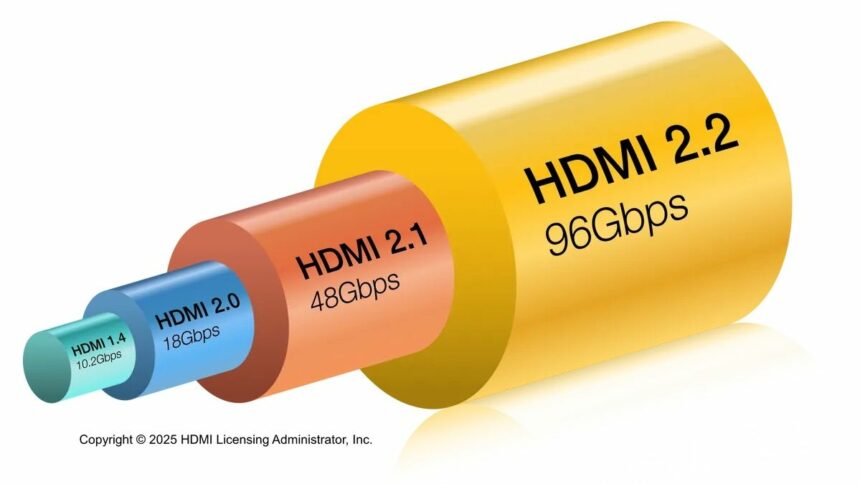
The headline number is bandwidth, and it’s a big one. HDMI 2.2 pushes throughput to 96Gbps, exactly double the 48Gbps ceiling of HDMI 2.1. That’s not an incremental bump; it’s a doubling of the data pipe, and it opens the door to resolution-and-refresh combinations that simply weren’t possible before.
What does all that headroom actually buy you? Quite a lot:
- Uncompressed 4K at 240Hz — pristine, full-fat 4K with the kind of refresh rate high-end PC players crave, with no compression in the chain.
- Uncompressed 8K at 60Hz RGB — native 8K with full color information intact, rather than chroma-subsampled shortcuts.
- With compression, the spec stretches even further: 8K at 240Hz and 4K at 480Hz.
Those last two figures are the eyebrow-raisers. A 4K display running at 480Hz sounds almost absurd today, but esports monitors have been chasing ever-higher refresh rates for years, and a single cable capable of feeding one is genuinely future-proofing. The same goes for 8K at 240Hz — a resolution-refresh pairing that’s been bottlenecked by interface limits rather than panel ambition.
It’s worth being clear about what HDMI 2.2 is. This isn’t a gadget you can pre-order or a box with a logo on it. It’s an open technical standard, the blueprint that TV makers, console builders, graphics card vendors and AV manufacturers will eventually bake into their hardware. No specific consumer product carrying HDMI 2.2 has been announced yet, and the standard only matters once devices on both ends of the cable support it.
That’s the catch with any new HDMI generation: the spec arrives first, and the ecosystem follows. To actually hit those 96Gbps numbers, you’ll need a source, a display and a cable that all speak HDMI 2.2. Expect the usual staggered rollout, with premium TVs and high-end GPUs likely leading the charge once 2027 hardware lands.
Still, the direction of travel is encouraging. Doubling bandwidth gives manufacturers room to stop making compromises — fewer compression trade-offs, more native color, and refresh rates that finally match where gaming displays are heading. For anyone planning a serious home-theater or PC-gaming setup down the line, HDMI 2.2 is the standard worth keeping an eye on.