Colin Angle knows a thing or two about getting robots into homes. He cofounded iRobot, the company behind the most successful consumer robots ever made, then stepped down as CEO two years ago. His next act is Familiar Machines & Magic (FM&M), a “physical AI” startup that has just revealed its debut creation: a robot simply called Familiar.
This isn’t a toy, and it isn’t aimed at kids. It’s a “physically embodied AI system designed to perceive, adapt, and interact with people in ways that feel natural and consistent.” Think of it less as a gadget and more as a vaguely magical, hyperloyal household entity that gets to know you, seeks you out for attention, and gently nudges you toward better habits.
The hardware is intriguing. The first Familiar is a quadruped with 23 degrees of freedom, enough for lifelike movement and expressive behavior. It’s wrapped in a custom touch-sensitive coat, equipped with a vision system, a microphone array and an audio system. The brains live entirely onboard: a custom small multimodal model optimized for social reasoning, fusing vision, audio, language and memory into real-time social responses. Crucially, it does not stream private data to the cloud — disconnect it from the internet and it still works, you just won’t get new features.
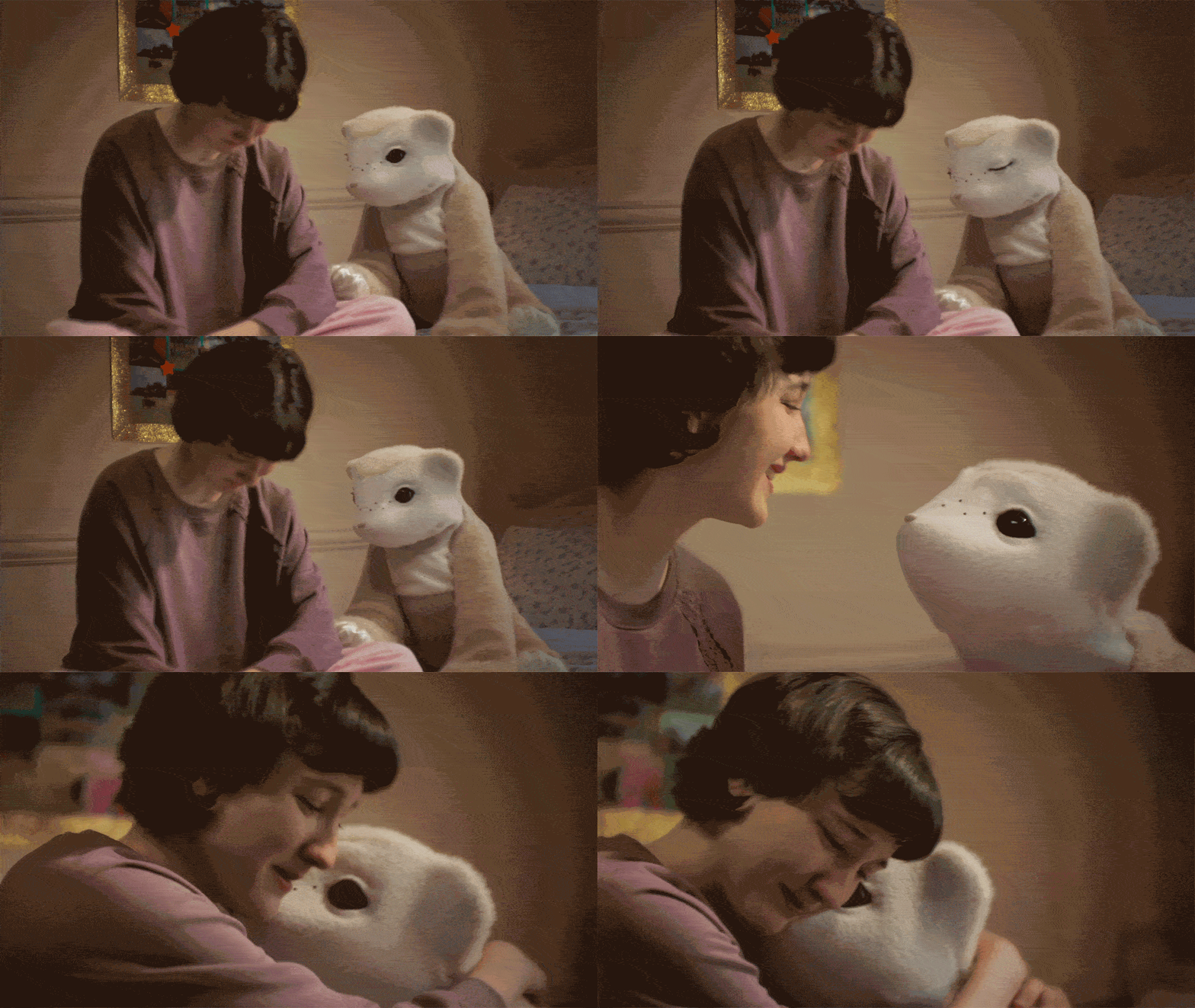
Angle describes the prototype as a deliberately abstracted bear, intentionally nothing like a dog or cat. The logic, borrowed from earlier social robots like Paro and Pleo, is that if you can’t map the form to a familiar animal, you won’t bring rigid expectations to it.
So what does it actually do? Angle pitches it as closer to a service animal than a pet. Spending too long doomscrolling? Familiar notices, then tries to lure you into something else — including taking it outside for a walk, which it can manage at regular human walking pace. “Within a few days,” Angle says, “it’s figured out what its role in your life is” — summoning people to dinner, greeting you at the door, or cuddling up during TV time.
Notably, Familiar doesn’t talk. “I don’t believe that the technology exists today for AI to talk to humans in a safe, responsible fashion,” Angle explains. Instead it communicates through sounds, a tail, wiggly ears, blinking eyes and an expressive brow. Behavior is genuinely non-deterministic: a tableau of inputs feeds the multimodal model, which decides at a high level what to do before a behavior engine drives a reinforcement-learning motion model.
Creative director Morgan Pope, a Disney Research veteran, points to a low center of gravity (it collapses safely downward if power is cut) and soft rubber, fur and padding for physical safety. Emotional safety matters too, with a “do no harm” philosophy aimed at avoiding the phone-style attention monopoly.
FM&M is candid about the category’s graveyard — Anki, Mayfield, Jibo — and about the marketing trap of overselling. “We are not building a robot,” Pope says. “We are building a relationship.”